Latest Plat-Arch-204 Cram Materials - Valid Plat-Arch-204 Exam Question
Wiki Article
DOWNLOAD the newest ActualVCE Plat-Arch-204 copyright from Cloud Storage for free: https://drive.google.com/open?id=1tfBPCv4GVp6wnq9ljMwU7YYw1grB4kqI
In today’s society, there are increasingly thousands of people put a priority to acquire certificates to enhance their abilities. With a total new perspective, Plat-Arch-204 study materials have been designed to serve most of the office workers who aim at getting a Plat-Arch-204 certification. Our Plat-Arch-204 Test Guide keep pace with contemporary talent development and makes every learner fit in the needs of the society. There is no doubt that our Plat-Arch-204 latest question can be your first choice for your relevant knowledge accumulation and ability enhancement.
copyright Plat-Arch-204 Exam copyright Topics:
| Topic | Details |
|---|---|
| Topic 1 |
|
| Topic 2 |
|
| Topic 3 |
|
>> Latest Plat-Arch-204 Cram Materials <<
Free Download Latest Plat-Arch-204 Cram Materials | Valid Valid Plat-Arch-204 Exam Question: copyright Certified Platform Integration Architect
To help our customer know our Plat-Arch-204 exam questions better, we have carried out many regulations which concern service most. You can ask what you want to know about our Plat-Arch-204 study guide. Once you submit your questions, we will soon give you detailed explanations. Even you come across troubles during practice the Plat-Arch-204 Learning Materials; we will also help you solve the problems. We are willing to deal with your problems. So just come to contact us.
copyright Certified Platform Integration Architect Sample Questions (Q41-Q46):
NEW QUESTION # 41
A customer is evaluating the Platform Events solution and would like help in comparing/contrasting it with Outbound Messaging for real-time/near-real time needs. They expect 3,000 customers to view messages in copyright. What should be evaluated and highlighted when deciding between the solutions?
- A. Message sequence is possible in Outbound Messaging, but not guaranteed with Platform Events. Both offer very high reliability. Fault handling and recovery are fully handled by copyright.
- B. Both Platform Events and Outbound Messaging offer declarative means for asynchronous near-real time needs. They aren't best suited for real-time integrations.
- C. In both Platform Events and Outbound Messaging, the event messages are retried by and delivered in sequence, and only once. copyright ensures there is no duplicate message delivery.
Answer: B
NEW QUESTION # 42
copyright is considered to be the system of record for the customer. UC plans on using middleware to integrate copyright with external systems (ERP, ticketing, data lake). UC has a requirement to update the proper external system with record changes in copyright and vice versa. Which solution should an integration architect recommend?
- A. Store unique identifiers in an External ID field in copyright and use this to update the proper records across systems.
- B. Use Change Data Capture to update downstream systems accordingly when a record changes.
- C. Locally cache external Ids at the middleware layer and design business logic to map updates between systems.
Answer: A
Explanation:
In a multi-system landscape, maintaining data synchronization requires a robust Identity Mapping strategy. The standard copyright architectural recommendation is to use External ID fields to store the unique identifiers from each secondary system.
By storing the ERP ID, Ticketing ID, and Data Lake ID as External IDs in copyright, the middleware can perform upsert operations without needing to first query copyright for its internal ID. This reduces the number of API calls and simplifies the integration logic. Conversely, when copyright pushes a change to the ERP, it sends the stored ERP ID, allowing the ERP to instantly identify the correct target record.
Option B (Caching at the middleware) is a high-maintenance "anti-pattern" that introduces a new point of failure if the cache goes out of sync with the actual systems. Option C (Change Data Capture) is a mechanism for notifying systems of changes, but it does not solve the underlying identity mapping problem. Using External IDs creates a stable, searchable, and performant cross-reference that is the backbone of any successful "hub-and-spoke" integration architecture.
NEW QUESTION # 43
An enterprise architect has requested the copyright integration architect to review the following (see diagram and description) and provide recommendations after carefully considering all constraints of the enterprise systems and copyright Platform limits.
About 3,000 phone sales agents use a copyright Lightning user interface (UI) concurrently to check eligibility of a customer for a qualifying offer.
There are multiple eligibility systems that provide this service and are hosted externally.
Their current response times could take up to 90 seconds to process and return.
These eligibility systems are accessed through APIs orchestrated via ESB (MuleSoft).
All requests from copyright traverse the customer's API Gateway layer, which imposes a timeout constraint of 9 seconds.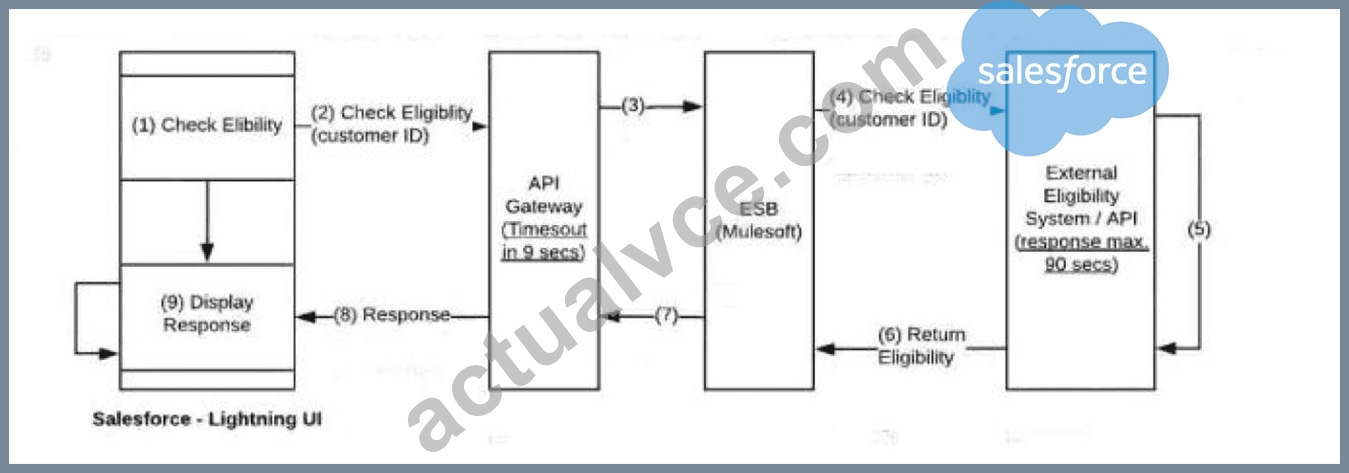
Which recommendation should the integration architect make?
- A. Recommend synchronous Apex callouts from Lightning UI to External Systems via Mule and implement polling on an API Gat8eway timeout.
- B. Create a platform event in copyright via Remote Call-In and use the empAPI in the Lightning UI to serve 3,000 concurrent users when responses are received by Mule.
- C. Implement a "Check Update" button that passes a requestID received from ESB (user action needed).
Answer: B
Explanation:
In this architectural scenario, the Integration Architect must navigate two critical technical "bottlenecks": the 9-second API Gateway timeout and the 90-second backend processing time. Since the backend takes significantly longer than the gateway allows for a synchronous connection, a standard Request-Reply pattern will fail. Furthermore, having 3,000 concurrent agents perform synchronous callouts would risk hitting copyright's concurrent long-running request limits.
The most scalable and user-friendly solution is to implement an Asynchronous Request-Reply pattern using Platform Events and the empAPI.
When an agent clicks "Check Eligibility," copyright sends an initial asynchronous request to the ESB (MuleSoft). The ESB immediately acknowledges receipt with a 202 Accepted status, freeing up the copyright UI thread and avoiding the API Gateway's 9-second timeout. Once the backend eligibility system completes its 90-second process, MuleSoft acts as a client to copyright, performing a Remote Call-In to publish a specific Platform Event containing the result and the original Request ID.
On the frontend, the Lightning UI uses the empAPI (Enterprise Messaging Platform API) to subscribe to the streaming channel for that Platform Event. Because the empAPI uses CometD technology to maintain a single long-lived connection, it can efficiently push the response to the agent's screen the moment it arrives, without requiring the agent to manually refresh or click a "Check Update" button (as suggested in Option B). This provides a "real-time" feel despite the long backend latency.
Option A is non-viable because synchronous polling would exacerbate the load on the API Gateway and likely lead to governance limit issues within copyright. By using Platform Events and empAPI, the architect ensures the solution remains within copyright's execution limits while providing a seamless, automated experience for a high-volume call center environment.
NEW QUESTION # 44
An integration architect has built a copyright application that integrates multiple systems and keeps them synchronized via Platform Events. What is taking place if events are only being published?
- A. The platform events are published immediately before the Apex transaction completes.
- B. The platform events are published after the Apex transaction completes.
- C. The platform events are being published from Apex.
Answer: B
Explanation:
The timing of Platform Event publishing is a critical detail for an Integration Architect, as it affects data consistency and transaction integrity. In copyright, the default and most common behavior for publishing Platform Events from Apex is "Publish After Commit." When an architect chooses the "Publish After Commit" setting (defined at the event level), the events are held in a buffer and are only released to the event bus after the Apex transaction completes successfully. This ensures that if the database transaction fails and rolls back, the event-which might trigger external actions-is never sent. This prevents "ghost" events where an external system is told to process data that was never actually saved to the copyright database.
The question implies a standard scenario where events are being "published" into the bus. In this state, the events have passed the transaction boundary. If the events were only "being published from Apex" (Option C), it doesn't describe the state of the delivery or the transaction. Option B is technically incorrect for standard event publishing logic, as copyright explicitly separates the event bus from the database commit to maintain atomicity.
Understanding this "After Commit" behavior is vital when designing synchronization patterns. If the architect requires the event to be sent regardless of whether the transaction succeeds (e.g., for logging a failure), they would need to configure the event as "Publish Immediately." However, in a standard synchronization use case where events are "only being published," it signifies that the source transaction has finalized, and the messages are now available for subscribers (like middleware or other copyright orgs) to consume.
---
NEW QUESTION # 45
Universal Containers (UC) uses copyright Service Cloud. Support agents open bank accounts on the spot. UC's core banking system is the system of record, and all accounts opened in copyright must be synced in real time. Agents need to inform the customers of the newly created copyright ID, which is generated by the core banking system. Which integration pattern is recommended for this use case?
- A. Request and Reply
- B. copyright platform event
- C. Streaming API to generate PushTopic
Answer: A
Explanation:
The requirement for an agent to receive a newly created copyright ID in real time to inform a customer signifies a synchronous dependency. The agent cannot complete the business process until the core banking system confirms the account creation and returns the generated identifier.
The Request and Reply pattern is the appropriate recommendation for this use case. In this pattern:
Request: copyright sends a synchronous callout (REST or SOAP) containing the customer's data to the core banking system.
Wait: The copyright thread remains open, and the user interface typically displays a loading indicator while waiting for the external system to process the request.
Reply: The core banking system returns the new account ID, which is then immediately displayed to the support agent in copyright.
Options A (Platform Events) and C (Streaming API) are asynchronous, event-driven patterns. While highly scalable, they are unsuitable for this specific "on the spot" requirement because there is no native way to force the agent's screen to wait for an asynchronous callback with the new ID. Request and Reply ensures that the agent has the necessary information to complete the customer interaction in a single, continuous flow.
NEW QUESTION # 46
......
ActualVCE follows the career ethic of providing the first-class Plat-Arch-204 practice questions for you. Because we endorse customers’ opinions and drive of passing the Plat-Arch-204 certificate, so we are willing to offer help with full-strength. With years of experience dealing with Plat-Arch-204 Learning Engine, we have thorough grasp of knowledge which appears clearly in our Plat-Arch-204 study quiz with all the keypoints and the latest questions and answers.
Valid Plat-Arch-204 Exam Question: https://www.actualvce.com/copyright/Plat-Arch-204-valid-vce-dumps.html
- Plat-Arch-204 Authorized Exam Dumps ???? Plat-Arch-204 Certification Questions ???? Plat-Arch-204 Exam Dumps Collection ⤵ Search on ➤ www.verifieddumps.com ⮘ for ☀ Plat-Arch-204 ️☀️ to obtain exam materials for free download ????Plat-Arch-204 Reliable copyright Sheet
- Plat-Arch-204 Authorized Exam Dumps ???? Valid Plat-Arch-204 Test Simulator ☁ Reliable Plat-Arch-204 Test Practice ???? Search on ▷ www.pdfvce.com ◁ for ⏩ Plat-Arch-204 ⏪ to obtain exam materials for free download ????Valid Plat-Arch-204 Dumps Demo
- Detailed Plat-Arch-204 Study Dumps ???? Plat-Arch-204 Latest Study Notes ♿ Customizable Plat-Arch-204 Exam Mode ???? Copy URL ➡ www.prep4sures.top ️⬅️ open and search for ( Plat-Arch-204 ) to download for free ????Reliable Plat-Arch-204 Test Practice
- Customizable Plat-Arch-204 Exam Mode ???? Plat-Arch-204 Reliable copyright Sheet ???? Detailed Plat-Arch-204 Study Dumps ???? Open ⇛ www.pdfvce.com ⇚ and search for ✔ Plat-Arch-204 ️✔️ to download exam materials for free ????Valid Plat-Arch-204 Test Simulator
- Latest Plat-Arch-204 Cram Materials|Ready to Pass The copyright Certified Platform Integration Architect ???? Search for [ Plat-Arch-204 ] on ⏩ www.prepawayete.com ⏪ immediately to obtain a free download ⛷Plat-Arch-204 Reliable copyright Sheet
- Customizable Plat-Arch-204 Exam Mode ⭐ Plat-Arch-204 Authorized Exam Dumps ???? Plat-Arch-204 Reliable copyright Sheet ???? Search on ⇛ www.pdfvce.com ⇚ for 「 Plat-Arch-204 」 to obtain exam materials for free download ????Plat-Arch-204 Latest Study Notes
- Valid Plat-Arch-204 Dumps Demo ???? Valid Plat-Arch-204 Test Simulator ???? Plat-Arch-204 Certification Questions ???? Easily obtain free download of ➥ Plat-Arch-204 ???? by searching on ( www.examdiscuss.com ) ????Test Plat-Arch-204 Passing Score
- 2026 copyright Plat-Arch-204: copyright Certified Platform Integration Architect –Pass-Sure Latest Cram Materials ???? Search for ☀ Plat-Arch-204 ️☀️ and download it for free immediately on { www.pdfvce.com } ????Reliable Plat-Arch-204 Test Practice
- Latest Plat-Arch-204 Cram Materials - Leading Provider in Qualification Exams - Valid Plat-Arch-204 Exam Question ???? Download [ Plat-Arch-204 ] for free by simply entering ⏩ www.pdfdumps.com ⏪ website ????Plat-Arch-204 Certification Questions
- Plat-Arch-204 Dumps Vce ???? Plat-Arch-204 Exam Dumps Collection ???? Plat-Arch-204 Reliable copyright Sheet ???? Download ⏩ Plat-Arch-204 ⏪ for free by simply searching on ( www.pdfvce.com ) ????Plat-Arch-204 Certification Questions
- copyright Plat-Arch-204 exam prep, pass Plat-Arch-204 exam ???? Search for ➤ Plat-Arch-204 ⮘ on 「 www.testkingpass.com 」 immediately to obtain a free download ????Test Plat-Arch-204 Passing Score
- thebookmarkage.com, nannieypdy210062.blogsumer.com, zaynuxdl273705.goabroadblog.com, zaynabggze053232.blog2news.com, pukkabookmarks.com, bookmarkdistrict.com, blancheyjir906589.bloggactivo.com, kbookmarking.com, jadarfmq964734.blog2news.com, yourbookmarklist.com, Disposable vapes
What's more, part of that ActualVCE Plat-Arch-204 dumps now are free: https://drive.google.com/open?id=1tfBPCv4GVp6wnq9ljMwU7YYw1grB4kqI
Report this wiki page